
Removing PPF should be uneventful — but only if it’s good film,
properly installed, and removed by a pro. Here’s what really
happens.
By Detailing Shoppe (a unit of Tyre Shoppe India Pvt Ltd) | Noida,
Delhi NCR
At some point, every PPF install ends. Either at the end of
warranty, when a new generation of film comes out, when the car is
resold, or sometimes earlier if the film fails. So the question every
prospective buyer asks: what happens to my paint when the film comes
off?
Honest answer: in most cases, nothing. Your paint is exactly as it
was the day the film was installed. Sometimes it’s actually better than
the day-old paint of an unwrapped car. But there are scenarios where
removal goes badly — and they’re worth understanding before you
buy.
The Best-Case
Scenario (And the Most Common One)
Quality TPU PPF, professionally installed, removed by a competent
installer:
-
Film peels off cleanly in large strips
-
Acrylic adhesive releases from the clearcoat without
bonding -
Any residual adhesive comes off with adhesive remover and a
microfibre cloth -
Paint underneath is identical to the day of install — original
gloss, original colour -
Often, paint under PPF is in better condition than adjacent
unprotected paint, because it hasn’t been exposed to UV, contaminants,
and washing for years
This is the experience for the vast majority of our customers when
they come back for reinstallation or removal.
How Professional
Removal Actually Works
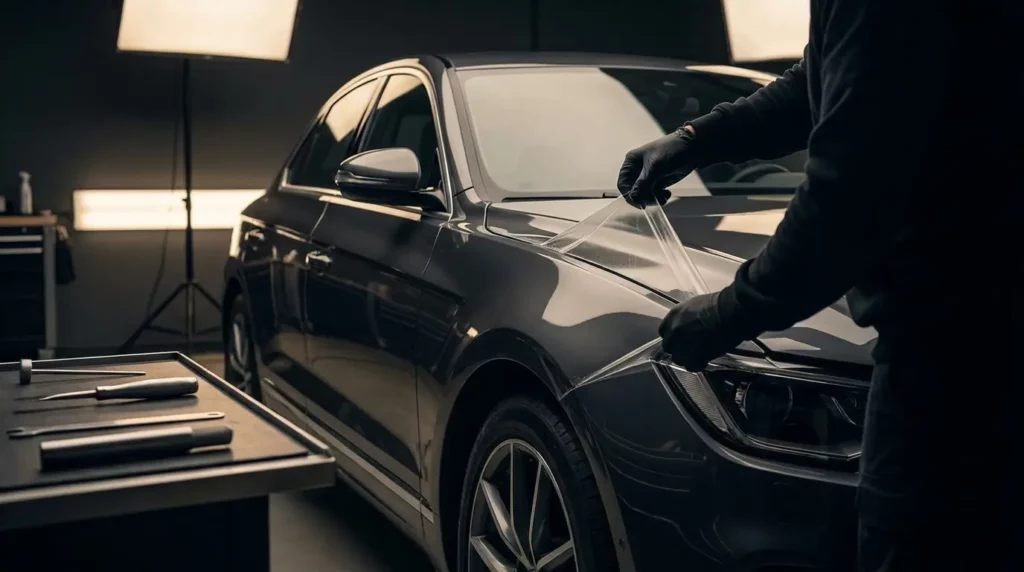
Removal at Detailing Shoppe uses:
-
Steam machine — softens the adhesive evenly across the
panel -
Plastic scraper (never metal) — for any remaining edges
-
Specific adhesive remover chemicals — formulated to dissolve
acrylic adhesive without attacking automotive clearcoat -
IPA wipe-down to neutralise the area
-
Inspection under detailing light to confirm no residue
Time required: 4–8 hours for a sedan, 6–12 hours for a full body
wrapped SUV. Done right, completely uneventful.
The
Worst-Case Scenario — Cheap Chinese Film Removal
This is where it goes wrong, and we see it monthly. Customers who got
cheap Chinese PPF installed somewhere else come to us either because the
film is failing or they want to upgrade.
What we find at removal:
-
Delamination — the TPU sheet has separated from
the acrylic adhesive. The top film comes off but the adhesive stays
bonded to the paint, sometimes in irregular patches. -
Aggressive adhesive bonding — cheap films often
use lower-grade acrylic adhesive that becomes increasingly aggressive
over time as it cures. After 18+ months, the adhesive can be so bonded
to the clearcoat that gentle removal isn’t possible. We’ve had cases
where pulling the film took the clearcoat with it. -
Hardened residue that requires aggressive
solvent treatment, which itself can dull the clearcoat. -
Yellowed paint patches from cheap films using
non-UV-stable adhesive that has chemically reacted with the underlying
paint.
In the worst case we’ve handled in the last year, a customer’s
full-body cheap PPF removal required complete repainting of three panels
at a cost of approximately ₹35,000 over and above the removal labour.
The original PPF cost him ₹28,000. Total cost of going cheap: ~₹63,000
plus weeks of car downtime.
Why You Shouldn’t Try DIY
PPF Removal
It looks simple on YouTube. It is not.
-
Without a steam machine, you can’t soften the adhesive evenly.
You’ll get uneven force applied to different sections, and that’s where
paint damage starts. -
Without proper adhesive remover, you’ll either leave residue
forever or use household solvents that attack clearcoat. -
Without panel-edge experience, it’s almost impossible to get film
out of door jambs and complex curves cleanly. -
Heat guns — which DIY guides recommend — applied incorrectly can
blister the paint underneath.
For quality TPU PPF in good condition, professional removal is around
₹6,000–₹15,000 depending on coverage. Skipping that to save money and
ending up with paint damage is a false economy of the highest order.
What About Removal at
the End of Warranty?
Most quality films don’t need to be removed at warranty expiry — they
continue to function for years past the warranty in most cases. We
typically recommend removal when:
-
Visible yellowing or cloudiness has set in
-
Self-healing has stopped working entirely
-
Edge lifting is widespread and can’t be reseated
-
You’re upgrading to a newer film generation
If the film is still performing visibly well, leave it on. There’s no
calendar deadline.
Will Removed PPF
Leave Visual Lines on Resale?
No, for quality films professionally removed. The paint underneath is
intact and matches the unprotected portions of the car perfectly.
In fact, cars sold with documented PPF history typically command
5–10% higher resale because the buyer knows the paint hasn’t been
exposed to wear. We provide our customers with their original install
documents specifically so they can show this to potential buyers.
Frequently Asked Questions
What happens to your paint when PPF is removed?
For quality TPU film professionally installed and removed, nothing changes — paint underneath is identical to the day of install, and often better than adjacent unprotected paint since it hasn't been exposed to UV or contaminants for years. This is the outcome for the vast majority of customers.
How does professional PPF removal actually work?
Removal uses a steam machine to evenly soften adhesive, a plastic (never metal) scraper for edges, specific adhesive-remover chemicals that dissolve acrylic without attacking clearcoat, an IPA wipe-down, and inspection under detailing light. It takes 4–8 hours for a sedan and 6–12 hours for a full body wrapped SUV, and costs ₹6,000–₹15,000.
What can go wrong when removing cheap PPF?
Cheap films can delaminate, leaving adhesive bonded to the paint in patches, or the adhesive becomes so aggressive over 18+ months that removal pulls the clearcoat off with the film. One documented case required repainting three panels for ₹35,000 on top of removal, after the original cheap PPF cost only ₹28,000.
Why shouldn't I try to remove PPF myself?
DIY removal lacks a steam machine for even adhesive softening, proper adhesive remover (forcing use of harsh household solvents), and experience with panel edges and door jambs. Heat guns recommended in DIY guides can blister paint if misapplied — professional removal avoids these risks for a modest ₹6,000–₹15,000 cost.
Does removed PPF leave visible lines or hurt resale value?
No, for quality films professionally removed — the paint underneath matches unprotected areas perfectly. In fact, cars sold with documented PPF history typically command 5–10% higher resale value, since buyers know the paint underneath wasn't exposed to years of wear.
Related Guides
- Does PPF Really Work or Is It a Scam?
- How Long Does Paint Protection Film Last?
- How Do I Maintain PPF to Keep It Looking New?
- Our Complete PPF & Paint Protection Guide for Delhi NCR
Visit Detailing Shoppe
Get a professional PPF removal — protect the paint
underneath.
Address: B-53, B Block, Sector 5, Noida, Uttar Pradesh 201301
Phone: 09991919148
Website: www.detailingshoppe.com
Authorised: 3M Platinum Partner (Noida) | Icon Rocklear
Authorised Applicator (North India)