
With the Yamuna Expressway, Delhi-Mumbai Expressway, Ganga Expressway, and Delhi-Dehradun Expressway all live or expanding, more Delhi NCR cars are clocking long highway runs than ever before. Which is great — except expressways are stone-chip factories. Loose gravel, truck debris, broken tarmac edges, and the worst offender of all: dumper trucks with un-tarped loads.
So the question we get every week: will PPF actually save my car’s paint from this stuff? Does PPF Prevents rock chips and scratches in this situation ? Here’s what 5 years of damage data from our Noida bay shows.
What PPF Stops — The Actual Damage Categories
PPF is engineered to absorb specific kinds of damage. Here’s what we routinely see absorbed by the film, with the paint underneath untouched:
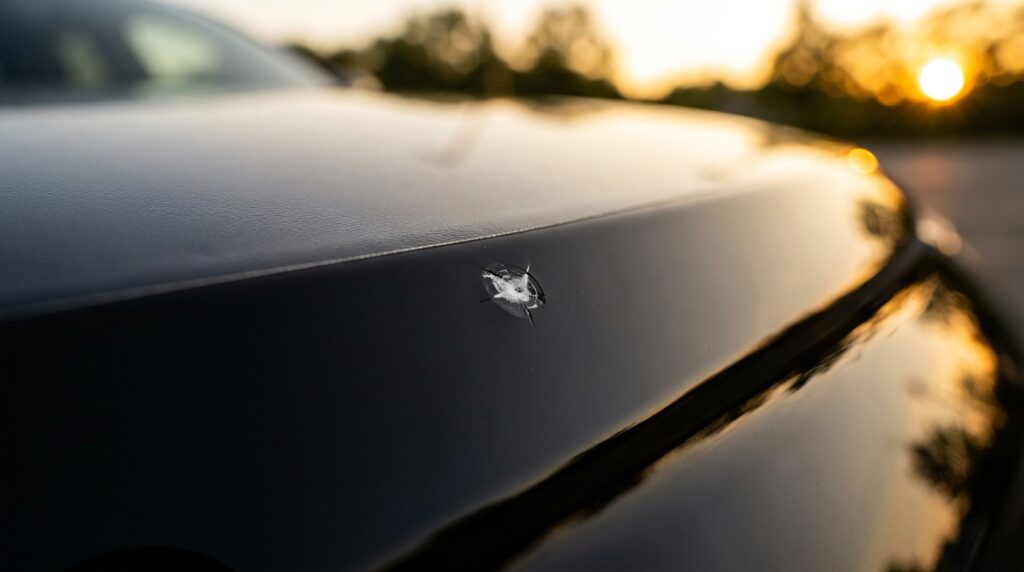
- Stone chips up to roughly 5–6 mm at highway speeds (the kind you get on Yamuna Expressway)
- Surface scratches from car wash brushes, valet keys, branches, parking ropes
- Light contact scrapes — rickshaw mirror, bike handlebar, shopping trolley
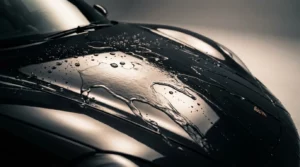
- Bird droppings, tree sap, insect splatter — these eat paint within hours in Noida summer; on PPF they wipe off without etching
- Bug splatter at highway speed which would otherwise leave permanent marks on clearcoat
- Light swirl marks from poor wash technique
- Door edge dings from neighbouring vehicles in tight parking
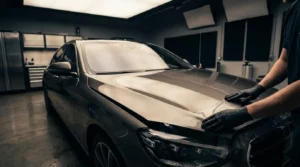
For all of these, a 190-micron Aliphatic TPU film — our standard at Detailing Shoppe — does its job. Above 190 microns (we go up to 210 microns on Supreme Pro Plus and similar films), the impact resistance increases proportionally.
What PPF Cannot Stop
We are not going to oversell. PPF is not body armour.
- Anything past parking speed will still dent the panel underneath, even if the film stays intact. The paint may be unmarked, but the metal will be deformed.
- A direct hit from a sharp object at high speed (think: rebar, large rock) will pierce the film.
- Hail bigger than 15–18 mm will dent panels even with PPF.
- Chemical damage from spilled fuel, brake fluid, or industrial solvents — PPF will protect the paint, but the film itself may stain.
What this means in practice: you should still drive carefully. PPF is insurance against the 100 small things that happen to every car, not against accidents.
The Highway Stone Chip Problem — Why Front Bumper PPF Is Non-Negotiable
Drive any of the new expressways in NCR for 6 months and pop the bonnet. Look at the leading edge of the hood. Look at the front bumper. You’ll see a constellation of micro-pits in the clearcoat, even if no chip has gone through to the colour layer yet.
This is what real-world expressway driving does to unprotected paint. Each pit is a future rust point if it reaches the metal, and each one drops the resale value subtly because it shows up under bright light at any inspection.
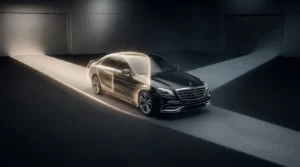
Front bumper, hood (full or halfway), and front fenders — what we call the “impact triangle” — is the minimum coverage we recommend for any car that does even occasional expressway driving out of Delhi NCR. Headlights too, because OEM headlight clearcoat is genuinely fragile.
Self-Healing — The Feature People Don’t Believe Until They See It

Quality TPU PPF has a self-healing topcoat. Light scratches — the kind your fingernail leaves — vanish when the film is exposed to heat. In Indian summer, 5 minutes of sunlight is enough. In winter, pour warm water on it. The scratch disappears.
This isn’t marketing. We demonstrate it on a sample card to every customer before they sign. What it means in practice: light wash-induced swirls and minor key scuffs don’t accumulate over years on a PPF-protected car. The car genuinely stays looking new for the entire warranty period.
Real Case: Innova Hycross + Supreme Pro Plus 210µ
A regular customer brought his Innova Hycross in after an auto-rickshaw scraped the front bumper at a market in Noida. The film had a clear gouge — but when we peeled the affected section, the original Toyota paint underneath was perfect.
Job done: replace half the bumper film. Customer downtime: 1 day. Without PPF: 7–10 days at the service centre, ~₹10,000 paint job, and a panel with a repaint history forever after.
This is not an outlier story. This is a Tuesday at our shop.

Visit Detailing Shoppe
Get expert advice on which panels of your car actually need PPF.
Address: B-53, B Block, Sector 5, Noida, Uttar Pradesh 201301
Phone: 09991919148
Website: www.detailingshoppe.com